

Glossary
PTFE - polytetrafluoroethylene
Polytetrafluoroethylene (abbreviation PTFE, also called polytetrafluoroethene) is a linearly structured, unbranched, partially crystalline polymer of fluorine and carbon.
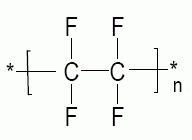
Known under the trade name Teflon ™ the company DuPont. Other trade names of PTFE are Dyneon PTFE (formerly Hostaflon) and Gore-Tex for PTFE membranes. PTFE belongs to the class of polyhalogenolefins, it is a thermoplastic, although it also has properties that require a more typical for thermosetting plastic processing. Teflon ™ is a nonpolar polymer. PTFE is not a byproduct of space travel. 1938 was discovered by chemist Roy Plunkett as he experimented with tetrafluoroethylene (TFE) refrigerant refrigerants. PTFE is made from chloroform CHCl3 by partial fluoridation. PTFE is very inert. Even aggressive acids like aqua regia can not attack it. PTFE has a particularly strong bond between the carbon and the fluorine atoms. Many substances fail to break bonds and react chemically. Because of its chemical inertness PTFE is known as Anticorrosion coating used. The friction coefficient is very low. PTFE slips on PTFE as well as wet ice on wet ice. In the field of sealing technology PTFE is used as a basic compound in many applications. It is also in the chemical plant used as lining material. Due to its low friction is PTFE as dry lubricant .
Rhenotherm Kunststoffbeschichtung GmbH performs contract coatings with PTFE (PTFE coating) and is certified as a contract coater according to DIN EN ISO 9001: 2015.